1st Lord Scott of Buccleuch 1565 to 1611
Scott Walter 4th of Buccleuch Born 1549 Died 1574 and lived at Bridgend
This is the first record of anybody staying in the Bridgend area.
The Usher Family of Bridgend Darnick
By the early 17th century the family had proliferated in the parish of Melrose. The name Usher appears on the very first page of the Parish records. The first entry is "George b 14/12/1626 - m. Bessie Tait of Gallowshiels". The Ushers belonged to the villages of Darnick and Briggend. In a letter from James Curle, Melrose, dated January 1855, he states "the family of Usher appear to have been large proprietors in Darnick for a period exceeding 250 years
In 1752 the lands of Toftfield (now Huntlyburn) were acquired by John Usher from Charles Wilkinson, a Writer in Melrose.
James Usher his only child had a large family. On April Fools Day in 1782 Andrew his third youngest of twelve children was born at Toftfield They didn't play about in those days! This Andrew went on to found the world famous Whisky Distilling and Blending Company of Andrew Usher & Co in 1813 and the famous Usher Brewery in Edinburgh in 1831. He claimed that he "fully maintained the character of the April Fool" in a narrative of his life which he wrote shortly before his death in 1855. Obviously he was more than that!
In 1816 the current John Usher of Toftfield. eldest brother of the April Fool Andrew, sold the greater part of Toftfield to his neighbour Sir Walter Scott who had by now built his famed Abbotsford House. At this time Toftfield included Harleyburn, now Chiefswood. Sir Walter Scott changed the name Toftfield to Huntlyburn which is what it is known as to this day. Also on Toftfield was Cauldshiels loch and Rhymer's glen where Thomas the Rhymer in ancient times used to meet the Queen of the Fairies (the Faerie Queen in Scottish). The following poem alludes to one such meeting:-
"True Thomas lay on Huntlie bank
a ferlie he spied wi his e'e;
And there he saw a ladye bright
Come riding down by the Eildon tree.
(Briggend) Briggend House
Elizabeth C. Clephane who was also a song writer (1830-1869) Born: June 18, 1830, Edinburgh, Scotland. Died: February 19, 1869, Briggend House, near Melrose, Roxburghshire, Scotland. Buried: St. Cuthbert's, Edinburgh, Scotland.Elizabeth was the third daughter of Andrew Clephane, Sheriff of Fife and Kinross. She lived most of her life in Melrose, Scotland, about 30 miles southeast of Edinburgh. She spent most of her money on charitable causes, and was known locally as "The Sunbeam."Clephane's hymns appeared posthumously, almost all for the first time, in the Family Treasury (1872), under the general title of "Breathings on the Border."
Bridgend House
Lucy Broadwood continued to visit Briggend House which is on the lowood estate near to where she was born, the Pavilion, as it was recorded by her cousin in 1907. Lucy would have been 49 years old by now, and 11 years old when Elizabeth C. Clephane died in 1869 but Lucy would have been too young to stay at Bridgend House at this time, so either someone else moved into Bridgend House after Elizabeth C. Clephane or else the family knew the person who stayed at Bridgend House between 1869 and 1907.
1st record of Lowood house.
Robert Reid, Master of Works and Architect to the King, from 1839 to 1856. could be the person who built the current Lowood House, in 1829 which was then called bridgend.
The Scottish Borders
Scotland's Oldest History
This area had an archaeological study done to find a iron age settlement going back 3,000 years, and was the same land Old Melrose was built on due to its fertile soil, then a Roman settlement 40AD to 450AD at Trimontium, Saint Columba 521 to 557AD Saint Cuthbert 635 to 687AD Newstead Village the oldest Village in Scotland possible 10th Century Ledgerwood Church first record 1127AD but dates back to the 11th Century making it Scotland's oldest church, Briggend we think dates back to 1050 AD. Trimontium, permission has been granted to start archaeological dig as this is the largest Roman site in Scotland dating back to 80AD to 500Ad. History going back 2,000 years
Below is the history of Briggend
from 1050AD
On reading this if you are in Melrose, you will find you are in the most historic part of Scotland within 20 miles. Half a mile from here lies Newstead, the oldest continuous inhabited village in Scotland. The area also has 4 Abbeys: Melrose, Dryburgh, Jedburgh and Kelso, dating back to 1132AD
The Borders were so wealthy there were around 2,400 houses that employed servants.
The local newspaper the Southern Reporter, was the main financial newspapers in Britain hundreds of years ago, and is still published today.
You will read about the Duke of Roxburgh of Floors Castle, and the Duke of Buccleugh:
These two houses were gifted all of the land between Berwick on the east coast to the west located at the Solway Firth where the border with England meets the sea, making them the richest land owners in the UK.
This land was gifted for services to the crown for signing over their armies
The Scottish Borders is not regarded in Scotland as part of Scotland.
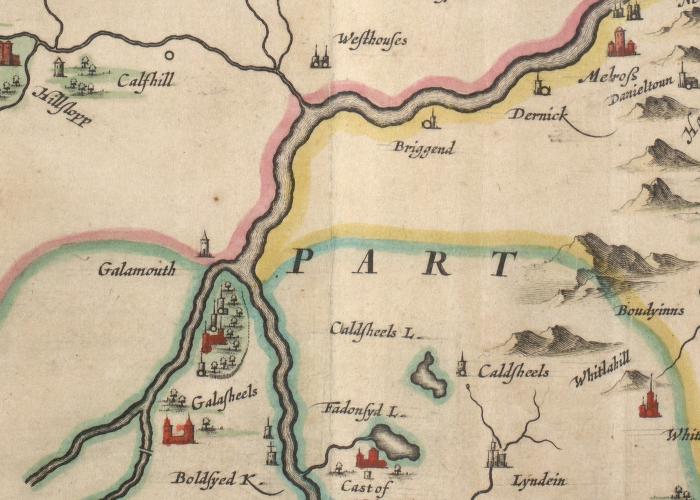
You are in the area of Briggend.
Below, you can read the information about Briggend from the possible 11th century up the present day. It's possible the Bridge predates Melrose Abbey 1132AD, and Ledgerwood Church 1127AD (the oldest church in Scotland, 12 miles from Melrose) I think the bridge origins could be around 1050AD
B Robertson - See Photos for more info
Archaeology Notes
NT53NW 41 c. 5197 3547
Location formerly cited as NT 5197 3547.
Bridge [NR]
(site of) [NAT]
OS 1:2500 map, 1972.
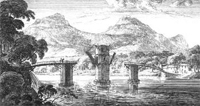
The site of a bridge, which had its origins in the 11th century but was rebuilt about 1544AD by the Pringle Family. This bridge, the only one on the river tweed between Peebles 20 miles west and Berwick 40 miles east, meant William Wallace and his Army had to use this bridge on his invasion into England, it was also used by English Armies when they tried to make Scots accept rule by England. The only alternative was to go by Carlisle on the west coast.
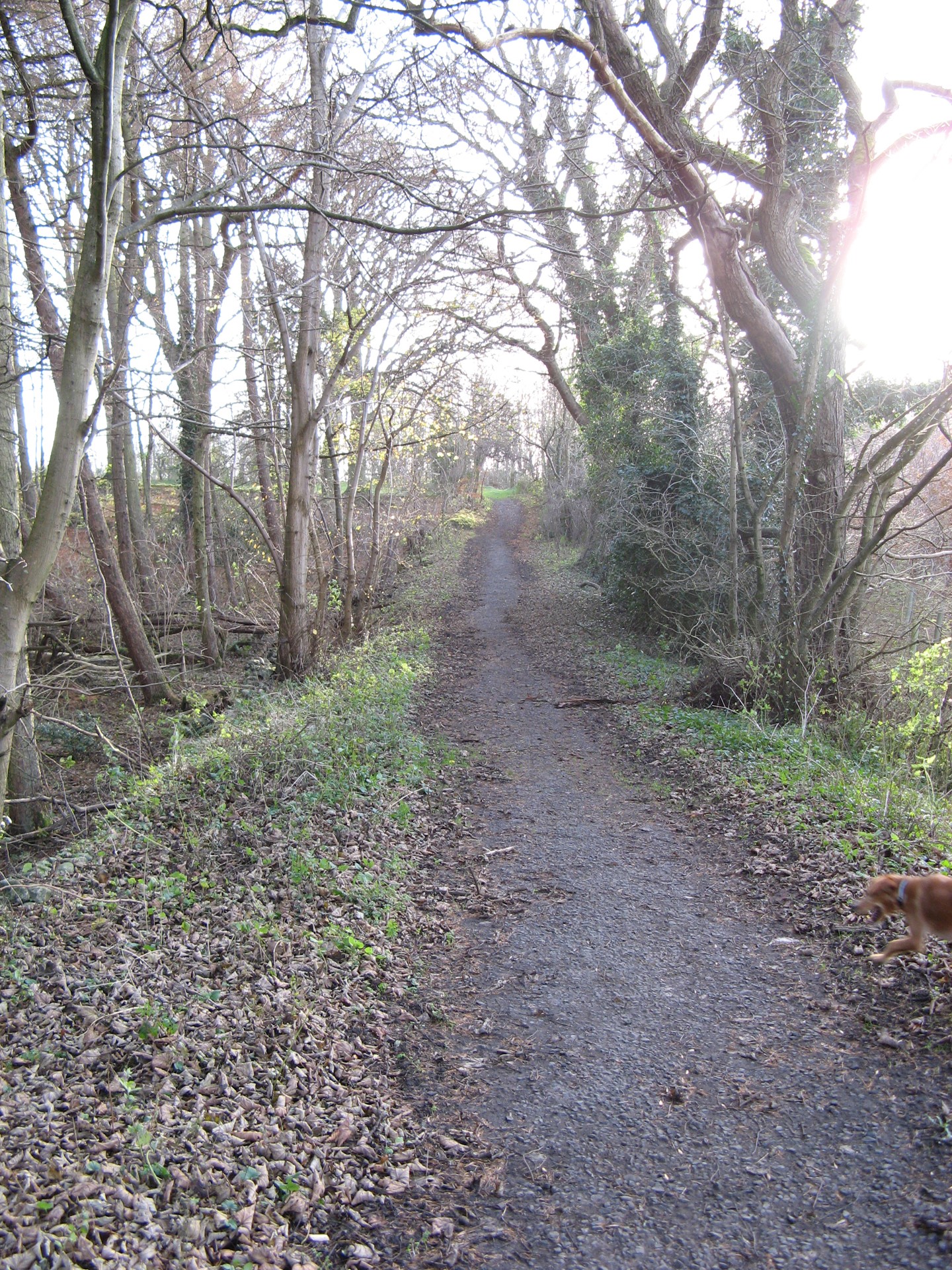
No trace of the structure survives but associated works can still be seen eg: the cutting back of a rocky shelf on the left bank to provide benching for an abutment built against the cliff-face; and the terrace of a zig-zag roadway rising towards the east.
RCAHM 1956
No trace of the bridge remains.
Visited by OS (WDJ) 26 January 1961
This bridge formerly carried a road across the River Tweed to the east of Galashiels.
Voici l'histoire de Briggend
Extract From THE ROADS THAT LED TO EDINBURGH, ETC. 43
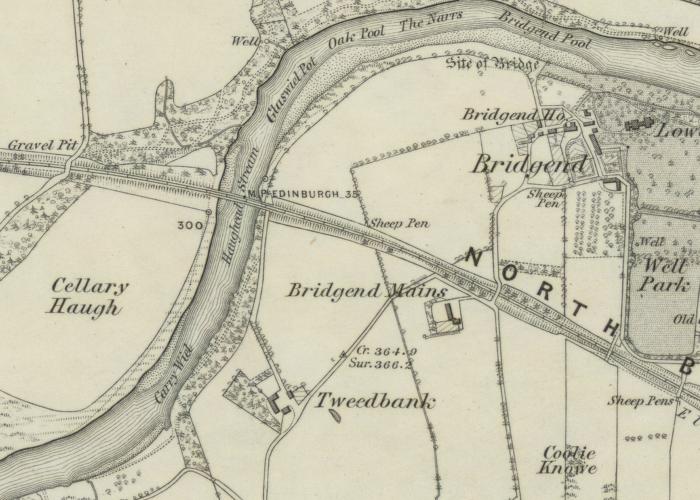
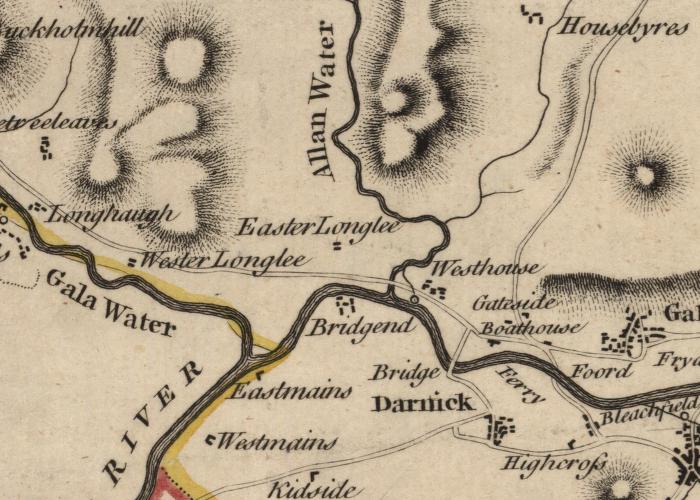
Below this map from 1863 shows the area once know as Briggend with roads and land marks we can still see today.
From the point of the river where the bridge crossed, you can see the road that winds it way past Bridgend House, through Bridgend, up through the wood where it splits, and both roads are dissected by the North British Railway.
At this point, one road leads up to Tweedbank Village, which I understand was a farm in its day, the other road goes on to join up with the Darnick to Abbotsford road, parts of which you can still see to this day in the Barret Housing Site.
The road that leads from Tweedbank down to the river, can also be seen today as it goes under the railway bridge and gives access to the fields called the sheep pen.
The railway cut through the middle of what must have been a community around Lowood House and bridgend in 1863
A Battle Site
This area of flat haugh land beside the River Tweed was the scene of a battle in 1526. Sir Walter Scott of Buccleuch, (Duke of Buccleuch) brought 600 riders in an unsuccessful bid to rescue the young King James V from the domination of the Earl of Angus and his allies, the Kers (Duke of Roxburgh) and Homes. In the ensuing combat the Scott faction lost more than eighty men and was routed, although one of Scott's servants, named Elliot cut down Ker of Cessford in the pursuit. The Southern Upland Way footpath crosses the site.
The Walter Scott in this story is not the Sir Walter Scott (1771-1832), Scottish writer and poet.
This was the drovers road from Bridgend linking up to the road to Abbotsford
Built in the 11th century replaced 1779AD
The area had two families who helped shape the Borders and beyond,
Andrew Currie,
a sculptor who carried out his work in a workshop in the grounds of Darnick Tower from about 1859 onwards. Amongst his work are: Mungo Park statue in Selkirk; The Ettrick Shepherd at St Mary's Loch, the Bruce Monument at Stirling; figures on the Scott Monument in Princes' Street Edinburgh. He died in 1891 and is buried in Weirhill Cemetery, Melrose.
The Smith family
- This family were builders and masons based in Darnick and working from the early 1800's through until the 1850's. Most of the major houses built in the area during this period were worked on by one of the family. A list of these reads like an index of the major works of the time: Melrose Parish Church, Dryburgh Abbey House, Chiefswood, Abbotsford (extension), Gattonside House, Yetholm Parish Church, St Boswells Schoolhouse, Eckford Church etc.
In addition to house and churches, they also built bridges amongst which are: North Bridge Hawick, Hermitage Water Bridge, Faulshope Bridge at Bowhill.
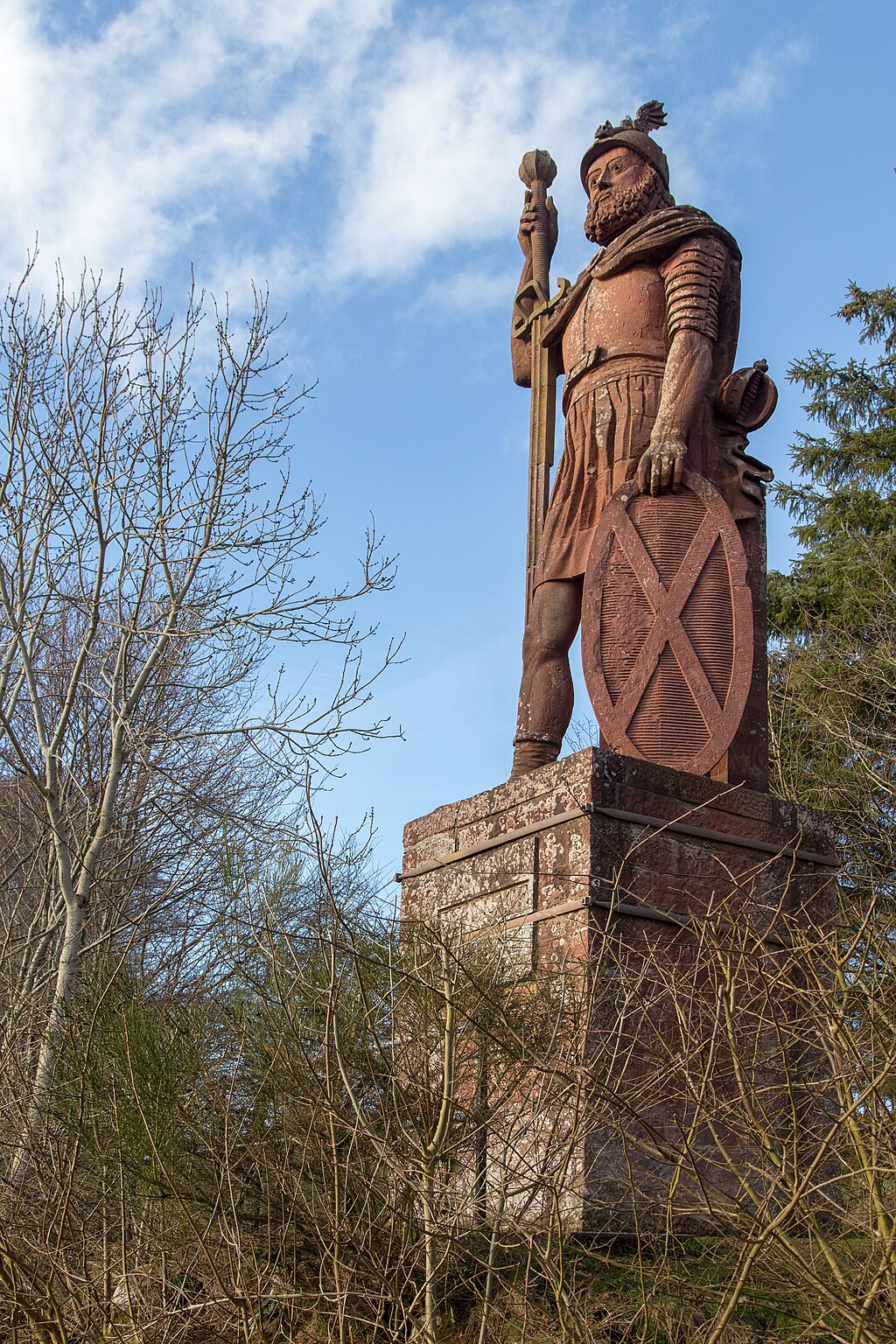
The Wallace Statue at Dryburgh was also the work of the family.
The Borders through time
In the Scottish Borders we don't have the names of well known Scottish Clans. It was Family names not clans. Most had a Castle or Keep with land and farm animals mostly cattle, and each family were reivers who would steal cattle from their neighbours, this was a wild and dangerous place living in fear of other families. Today all the Border towns: Hawick, Selkirk, Galashiels, Kelso, Jedburgh, Earlston, Coldstream hold Border Civic weeks, they ride the Marches on horse back every year in memory of the towns and associated families.
Unlike the highlands who sufferd the higland clearenses driving families of there land and having their houses burnt down, the Lowlands/Scottish Bordres suffered a different fate as the English crown gave all the land between the east coast to the west coast to two Families the Kerrs, and the Scots, who are now known as the Duke of Bucclugh and the Duke of Roxburgh. But unlike the higlands the Borders became very welthy resulting in having 2,400 houses that employed servents, and the Borders became the welthiest part of Scotland with the local newspaper the Souther Reporter became the Financial News Papers in Britain, which is still published today.
The population of the Borders today is 116,000, very small given the size of the Scottish Borders
Below are the Border Reiver Family Names, see if you are one.
Anderson * Archibold * Armstrong * Aynsley * Beattie/Bettisoun * Bell* Blackadder * Brewis * Bromfield * Burns * Carlisle * Carlton/Charlton * Carnaby * Carr/Kerr * Carruthers * Cessford * Chrichton * Clennell * Cockburn* Collingwood * Corbett * Coxson * Cranston * Craw/Crawford * Crisp * Crozier * Curwen * Cuthbert * Dacre * Dalgliesh * Davison/Davidson * Delaval * Dickson/Dixon * Dodd * Douglas * Dunne * Edgar * Ellerker * Elliot * Errington * Fenwick * Fluke * Forster/Foster * Fraser/Frissell * Gilchrist * Glendenning * Gordon * Graham * Gray * Hall * Halliday * Harden * Hedley * Henderson * Heron * Hetherington * Hodgson * Horsley * Hume/Home * Hunter/Huntley * Irvine/Irving * Jamieson * Jardine * Johnstone * Kirkpatrick/Kilpatrick * Laidlaw * Latimer * Little * Lowther * Maxwell * Medford * Milburn * Mitford * Moffat * Mow * Musgrave * Nicholson * Nickson/Nixon * Noble * Ogle * Oliver * Ord * Percy * Pile * Potts * Pringle * Radcliffe * Redhead * Redpath * Reed/ Reid * Richardson * Ridley * Robson * Rome * Routledge * Rowell * Rutherford * Salkeld * Sawfeld * Scott * Selby * Shaftoe * Simpson * Snowden * Stamper * Stapleton * Stokoe * Storey * Strowther * Swinhoe * Swinton * Tailor/Taylor * Tait/ Tate * Telfer * Thompson/ Thomson * Trotter * Turnbull * Turner * Vardy * Wake * Wallace * Wanless * Watson * Widdrington * Wigham * Wilkinson * Wilson * Witherington * Yarrow * Young *
A BRIEF HISTORY OF THE WAVERLEY ROUTE
Following the Smith-Barlow Commission investigation of 1839, into the feasibility of trans-Border Anglo-Scottish trunk routes, the Government decision in 1841 stating that only one trans Border route was viable seriously underestimated the potential for long distance traffic.
The North British Railway were granted Parliamentary approval for the first trans-Border route between Edinburgh & Berwick, via the East coast, in 1844. This was a new company at the time, and the founder of the N.B.R., John Learmonth, already had plans in mind to serve the whole of the Borders region between Edinburgh, Carlisle & Berwick with a railway network. He knew, however, there would be very little traffic generated in parts of this region due to the fact it was largely agricultural.
Undeterred, he pressed on with his plan, if not somewhat slightly over-optimistic of the actual traffic potential. The following year, in 1845, the N.B.R. acquired the Edinburgh & Dalkeith Railway, constructed by James Jardine in 1831, for the princely sum of £120,000 and also absorbed the Marquis of Lothian's Waggonway, of 1832, further south. As a point of interest, the Edinburgh & Dalkeith Railway was surveyed as long ago as 1818, by one Robert Stevenson (who recently featured on the BBC series "Seven Wonders of the Industrial World") and received Royal Assent on 26th May 1826.
The acquisition of these lines would provide another stepping stone to the south, without bringing too much attention to themselves, or so they thought. Their plan, soon to be unveiled, was to build the "Edinburgh & Hawick Railway", by way of Galashiels & Melrose.
Feedback email
tweedbankbill@aol.com
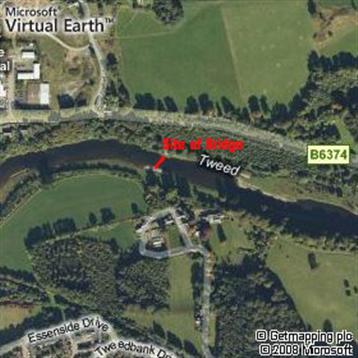
Red markes the point
the bridge crossed
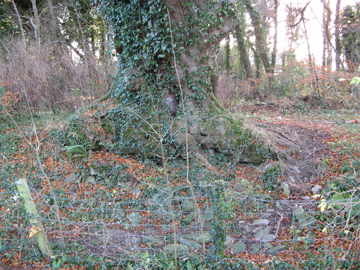
This tree could be more than 600 years
old and is listed as a important tree